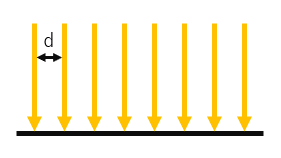
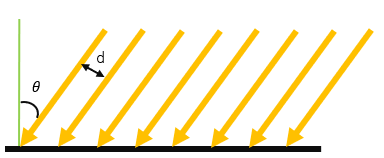
當平行光以非垂直角度照射表面時,光線在表面上的間距會被拉長。設光線垂直投影的間距為 、表面上的實際間距為 、入射方向與法線的夾角為 ,間距線 與表面的夾角為 。
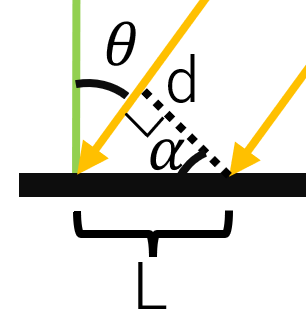
法線垂直於表面, 垂直於光線。設光線與表面的夾角為 ,則:
因此 。直角三角形中 ,代換後得到:
整理後得到:
當 越接近 90°,光線在表面上的分佈越稀疏,這也說明了斜射光在單位面積上提供的能量較少。
平行光以非垂直角度照射表面时,光线在表面上的间距会被拉长。设光线垂直投影的间距为 、表面上的实际间距为 、入射方向与法线的夹角为 ,间距线 与表面的夹角为 。
法线垂直于表面, 垂直于光线。设光线与表面的夹角为 ,则:
因此 。直角三角形中 ,代换后得到:
整理后得到:
当 越接近 90°,光线在表面上的分布越稀疏,也说明斜射光在单位面积上提供的能量更少。
When parallel light hits a surface at an oblique angle, the spacing between rays along the surface becomes larger. Let be the spacing in the perpendicular projection, the actual surface spacing, the angle between the incident direction and the surface normal, and the angle between the spacing segment and the surface.
The normal is perpendicular to the surface, and is perpendicular to the rays. Let be the angle between a ray and the surface. Then:
So . In the right triangle, , and substituting gives:
Rearranging gives:
As approaches 90°, rays become more sparsely distributed across the surface. This also explains why oblique light contributes less energy per unit area.
平行光が面へ斜めに入射すると、面上での光線間隔は長くなります。垂直投影での間隔を 、面上の実際の間隔を 、入射方向と法線の角度を 、間隔線 と面の角度を とします。
法線は面に垂直で、 は光線に垂直です。光線と面の角度を とすると:
したがって です。直角三角形では なので、代入すると:
整理すると:
が 90° に近づくほど、面上の光線分布は疎になります。これは斜めからの光ほど単位面積あたりのエネルギーが小さくなる理由でもあります。
| Perpendicular | Oblique |
|---|---|
 |
 |
References
- Feng Lele (2016), Unity Shader 入門精要, Posts & Telecom Press
- GAMES 101 — 現代計算機圖形學入門